
Read This First!
We'll start from the beginning, here.
The municipality that provides your home with water, has to have a reservoir system that can hold enough water at one time, so it can supply an adequate flow of water to thousands of homes, so that if they all use water at the same time (during peak times in the morning for work prep, or during dinner preparation, or at night for showers and baths), the reserve won't be depleted. There are pumps that continually replenish those reservoirs, filling them back up at a slower rate (for a longer time) than we drain them at one time.
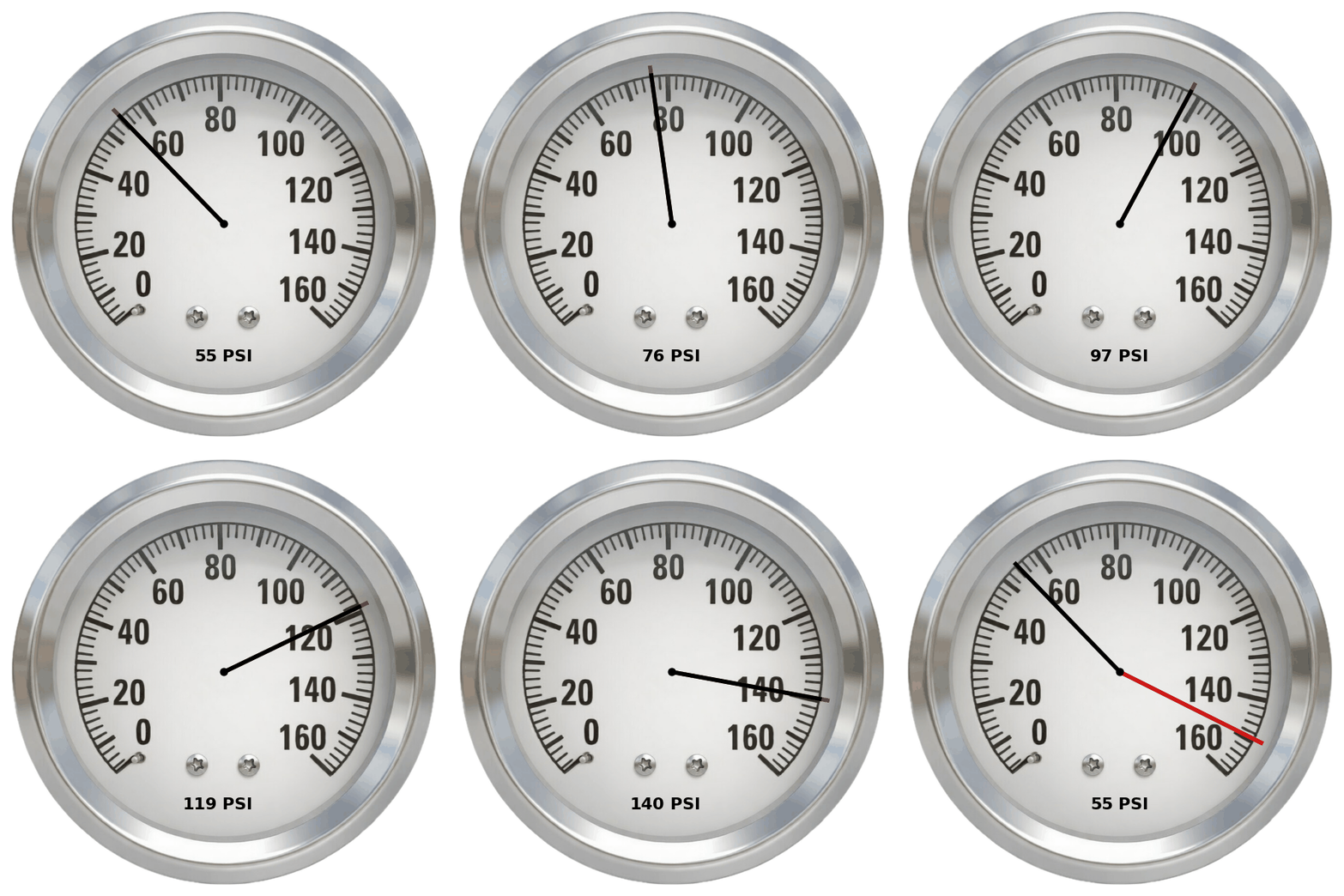
Because of the need for the massive amounts of stored water, the line pressure (the city pipe pressure) is almost always considerably higher (up to 200 pounds per square inch, or PSI) than what you'd want in your home (around 55 PSI).
Because of this, The Uniform Plumbing Code (UPC) (Section 608.2) requires a pressure reducing valve (PRV) whenever the static water pressure in the water supply piping exceeds 80 psi . This was required by the builder of your home, so you should be able to find this regulator just above the main shut-off valve where your water enters your home. The bolt on the side of it, going into a bell-shaped housing, is to adjust the pressure at which the regulator shuts down the water supply to your house. This happens without you realizing it. The regulator's internal shut-off mechanism shuts the city water off when it senses that the pressure on the house-side of it equals the pressure level that was set with that bolt. When you open a faucet in the house, the house-side pressure lowers, thereby opening that internal shut-off valve to let the city pressure flow freely. When you turn off your faucet, the regulator senses the rising pressure in your pipes, and turns off again, so you don't receive the city's full high pressure.
It's a great system, but it isn't perfect.
Your city draws water from the ground, or from the cheapest means possible (through aqueducts, or long-range piping networks), but most of the time it comes from wells drilled in different parts of the surrounding area, into bodies of water beneath you called aquifers. The water that comes from the ground picks up the junk from the dirt. Technically, these are called ions; an ion is, simply put, an atom of some substance, such as calcium or magnesium, that has fewer (or more) electrons than it has protons, which makes it want to "stick to" the molecules of water that "pick it up" while they flow past the ion. It's like a magnet that sticks to an individual water molecule. The calcium ion will stick to that water molecule until it finds a more attractive place to stick to. Do you see where this is going, yet?
So when the water goes through the regulator at your house, sometimes the calcium ions will want to stick to the rubber seal area that keeps the regulator closed (when your faucets are all off). When the water rushes past this open valve, and rubber washer area (when you turn a faucet on), it "wants" to jump off the water molecule, and grab onto the rubber seal. After some time, depending on the amount of calcium in the water (or "hardness") of the municipal water supply (it's really bad in the southwest) the rubber will go from being perfectly flat, and stopping the water when it needs to, to full of microscopic mountains and valleys (like the palm of your hand, but smaller), and then, even when the regulator is trying to shut the city water off (when you're no longer using your faucet), small amounts of water "bleed-through" will get past the regulator, raising your home's water pressure very slowly, until it reaches the full city water pressure (as shown on the gauge above, but slower). Then it's just pushing, always pushing, until the weakest fitting breaks and your house floods at full flow, or until you use water in the house, lowering that built up pressure back down to about 55 PSI, and then rising again, and again, whichever comes first...
So how do you know it's happening?
If you put a gauge on a hose bib, and check the reading, you just released the pressure a little bit when you turned on that hose bib and the water flowed into that area of the gauge, or if any water came out of a loose packing nut on top, that could release the built-up pressure, or if you turn the hose bib on first, you would have released it. If your pool's auto-refill float's supply line is on, it could release the built up pressure momentarily, or if your reverse osmosis drinking water supply line is on, it may stop you from seeing the rise in your pressure, or if your toilet is refilling, or if a family member is using the faucet... So, turn off everything that could release the building pressure, so you can watch the gauge for five full minutes.
If you do all of that, and your pressure rises even so much as one PSI over five minutes, you are getting high pressure every night (when you're sleeping and no one is using water for longer periods of time). Change your regulator. don't forget to turn your valves back on afterward.
You can stop the water pressure from going over 80 PSI, and warn you that it's no longer 55 PSI, by using a patented Pressure Guard™ on any hose bib around your house. It's easy to install; just thread it onto a hose bib just like a hose. When your regulator fails, the Pressure Guard™ drips onto the ground just enough to offset the bleed-through of a calcified regulator, keeping your pressure under 80 PSI. When you see it drip, you know it's protecting you.
For under a hundred bucks, why would you not protect your home?
Protect Your Home with Pressure Guard™
Don't wait for a disaster. Get the protection your home needs today.
Shop NowRelated Articles
You need to change your pressure regulator!
This is a picture of an old regulator that is NOT working, and a new one that should replace it... This is a story about a home with an old regulator that the owner refuses to change. →
Why you need a thermal expansion tank
...the water expands by about 0.6–0.65 gallons...Pressure often rises 60–150+ PSI above normal... →