
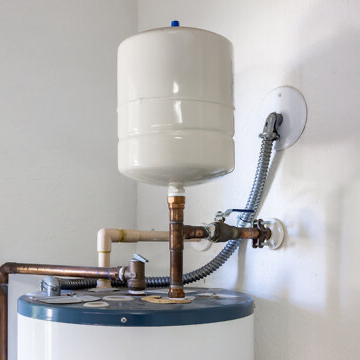
Why you need a thermal expansion tank
Thermal expansion pressure spikes in a closed home plumbing system (most modern homes with a pressure-reducing valve or backflow preventer) are a silent, repeated threat. Without proper protection, every time your water heater cycles (heats water), the system gets hammered with dangerously high pressures — leading to weakened pipes, leaking joints, premature water heater failure, dripping T&P valves (which can build up calcium and fail), and eventual bursts that flood homes.
Here are the real PSI numbers for a typical average home (2–3 bathrooms, standard pipe runs) with a 50-gallon tank water heater in a closed system. Normal incoming cold water pressure is usually 40–80 PSI (average ~60 PSI).
Without Any Protection: The Pressure Spike Range
When the heater warms the water (typically from ~90 °F incoming (in the southwest), to 120–140 °F set-point), the water expands by about 0.6–0.65 gallons total in the system. If you live in an area with colder incoming water, the total expansion can be a lot more.
Because water is nearly incompressible, that extra volume converts to extreme pressure:
Pressure often rises 60–150+ PSI above normal in a single heating cycle.
Real examples from manufacturer tests, plumber demos, and engineering sources:
Starts at 60 PSI → climbs to 120–180 PSI (or higher, up to 200–300 PSI before the standard T&P valve opens at its "150 PSI" set point).
In many documented cases, pressure hits 150 PSI (the T&P activation point, when they actually work) quickly, dumping hot water down the drain or floor as a safety last resort.
This isn't a one-time thing — it happens every recovery cycle (multiple times a day in busy homes), stressing everything repeatedly.
How fast does the spike happen? (Speed depends on heater recovery rate, not total PSI rise)
Natural gas or propane water heater (fast recovery): Pressure can surge from normal to 150+ PSI in just 4–10 minutes (sometimes even a few minutes). Gas/propane heats quickly, so the expansion builds rapidly — gauges jump fast, T&P valves drip or sputter noticeably. Even worse, the T&P valves sometimes don't even open before dangerous pressure levels can break the weakest part of your plumbing system, and then flood your home.
Electric heaters take longer (20–40+ minutes for the same rise), but still reach the same dangerous pressure.
The fuel type doesn't change the final pressure — only how quickly it gets there.
With a Properly-Sized Thermal Expansion Tank: What Happens Instead
A standard expansion tank absorbs the extra volume into a compressed air bladder, keeping pressure stable.
Pressure rise is minimal: usually only 5–15 PSI above normal (often 0–10 PSI in well-tuned systems).
Example: Normal 60 PSI stays 60–75 PSI max, even during a heater's full capacity heating.
No repeated slamming, no frequent T&P dripping, no accelerated wear.
Your Patented Solutions: Pressure Guard™ and Pressure Peace™
Unlike a traditional expansion tank (which absorbs expansion to prevent spikes), the Pressure Guard™ is a specialized pressure relief valve (opens at 75 PSI) with a built-in flow restrictor. It doesn't let pressure blow out uncontrollably — it drips just enough controlled water to counteract:
Thermal expansion from the water heater, or
"Bleed-through" from a calcium-buildup-damaged pressure regulator (PRV) that's failing to hold steady.
This keeps system pressure safe below critical levels without wasting gallons or flooding the area.
The Pressure Peace™ add-on (connects to the Pressure Guard's outlet) takes it further:
Uses electronics to analyze the small water release, in real time.
Diagnoses the root cause: Is it thermal expansion? A bleeding pressure regulator? Or a failed bladder in an existing expansion tank?
Sends the data to our system, then notifies the customer's smartphone with the diagnosis.
Offers to dispatch a trusted pro for the fix.
The outdoor Pressure Guard™ drips onto the ground, and the indoor unit drips into your kitchen sink drain through a ¼" tube.
This turns a simple safety drip into smart, proactive protection — homeowners get peace of mind, early warnings, and professional help before small issues become disasters.
These numbers aren't abstract — they're why codes require protection, why T&P valves drip chronically without it, and why homes flood unexpectedly. Our products give people control and a diagnosis they can't get anywhere else.
If you have a tank water heater, you should definitely have a thermal expansion tank. We are developing one right now that you can install by yourself. If you want one right away, please call a plumber to set one up, over your water heater, as shown above. If you don't have one, and you use a Pressure Guard, that Pressure Guard will drip, about fifteen minutes after you use a good amount of hot water. This is a great temporary solution to intermittent thermal expansion, but you should also get a thermal expansion tank, for sure.
Protect Your Home with Pressure Guard™
Don't wait for a disaster. Get the protection your home needs today.
Shop NowRelated Articles
Read This First!
...the line pressure (the city pipe pressure) is almost always considerably higher (up to 200 pounds per square inch, or PSI)... →
You need to change your pressure regulator!
This is a picture of an old regulator that is NOT working, and a new one that should replace it... This is a story about a home with an old regulator that the owner refuses to change. →