
You need to change your pressure regulator!
This is a story about a home with an old regulator that the owner refuses to change.
Let’s call the owner Bernie.
So, Bernie called a company to come out to his house and change the filters on his reverse osmosis drinking water system (his RO). The tech turned the supply line to the RO off, and then went to the side of the house and checked the water pressure at the hose bib that was located just downstream of the pressure regulator.
Sure enough, the water pressure was creeping up. It went up by 1/10th of a pound per square inch (PSI) every few seconds. This happens because the water in his area is very “hard”, containing a high level of calcium-ions in the water (connected to the water molecules). When those ions move past the shut-off point of the regulator, they like to jump off the water molecules, and onto the rubber seals. This starts happening immediately upon installation, but the more time that goes by, the more water goes by, and the more calcium-ions (and other metals, like magnesium, and manganese, and others…) stick to the once-perfect seal, until it has massive microscopic mountains and valleys (look at the palm of your hand for a bigger-scale model) which then causes water to “bleed through” the shut-off point of the regulator, until your house pressure equals the city pressure which is very high, especially overnight, when fewer people are using water.
So the tech tells this story to Bernie, and Bernie says he’ll do it himself, you know, to save money.
But guess what?
Bernie didn’t.
So the tech gets a call two years later to do another service call on the RO. But this time, there are a whole bunch of flattened, leaky o-rings that have to be replaced. The auto-shut-off valve needs replacing, the membrane is producing worse-quality water, and the regulator is still old, has never been changed, and Bernie still won’t change it. In fact, he tells the tech that he just changed it recently.
He didn’t.
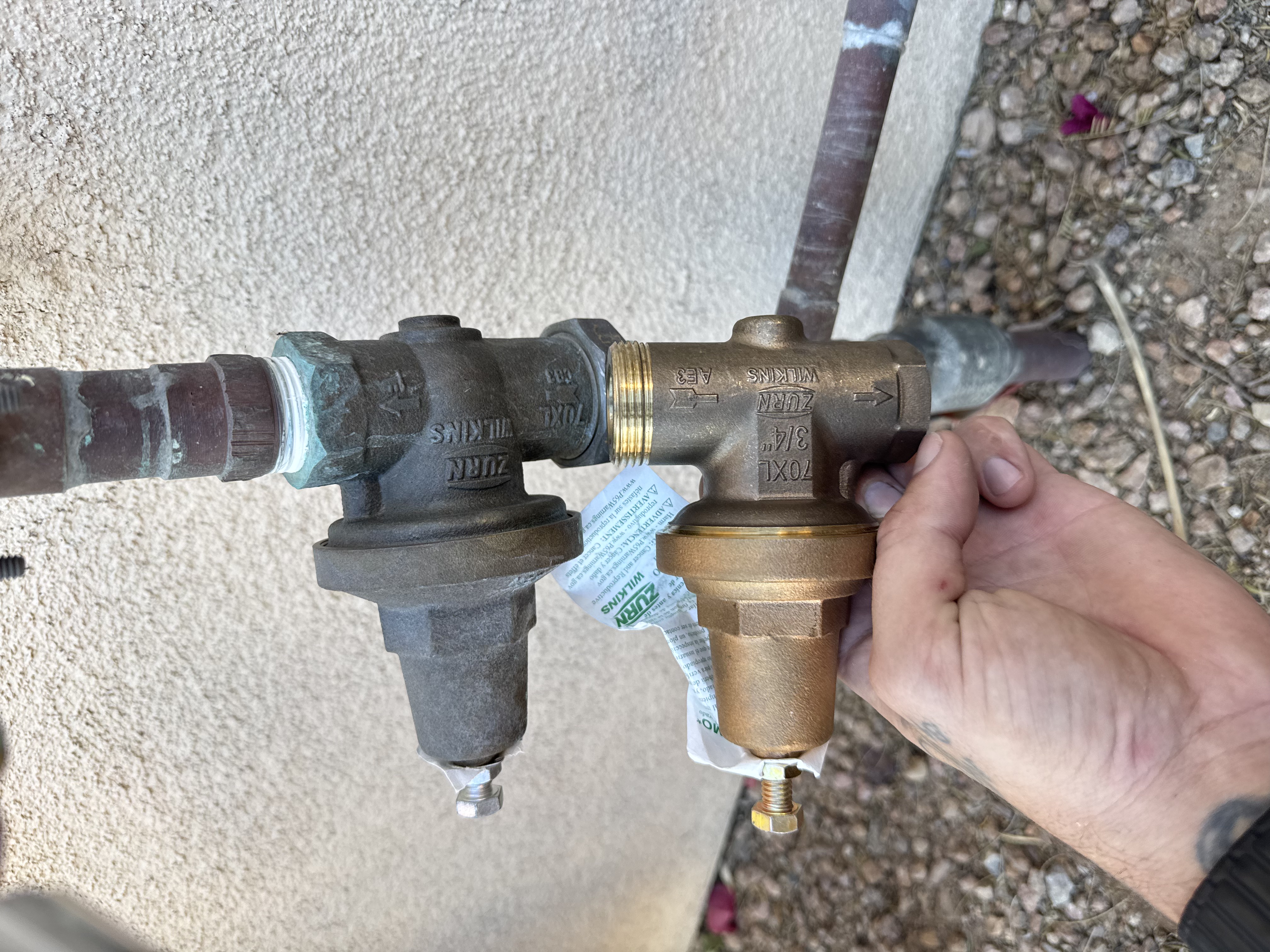
Regulators don’t get that dark in a matter of only a few months. You see, regulators are made of brass (most of them), and that brass patinas in the UV light of the sun, steadily over time. A person whose been at it for a long time can tell approximately how old a regulator is by the color of its housing. Its easy to see the difference in color between the two regulators in the above photo. The attached one is about six years old, and the one in the tech's hand is brand new.
I’d bet money that when Bernie’s house floods, he won’t be calling that same tech. it's difficult for some people to have to come to grips with their lack of wisdom.
There’s a very easy way to see if you have a slow “invisible” regulator “bleed-through”. Get a Pressure Guard™. Attach it to a hose bib. Turn on the hose bib. If the Pressure Guard™ softly drips onto the ground during the night, it means you had high water pressure enough to open its pressure relief valve.
For just $99, why would you not protect your home?
Don’t be a Bernie.
Protect your home.
Get a Guard!
Protect Your Home with Pressure Guard™
Don't wait for a disaster. Get the protection your home needs today.
Shop Now